

Salmon Fishing

Salmon fishing begins on 1st February, although there is no appreciable spring run nowadays, with only the occasional fish or small pod likely, particularly in May.
Salmon and grilse can be caught throughout the summer, but the river’s main run is in September, when fish numbers are at their strongest and conditions often suit both fly and spinning. Although the season closes on 30th September, salmon are frequently present in the river beyond this date, and fish may still be encountered during October and November.
The Dart can change quickly with weather and water levels, and salmon activity is often closely linked to river height and colour. Fresh fish often appear after water increases, while prolonged low water may require a more subtle approach, smaller flies, and careful presentation.

Where to Fish & Visitor Water
The visitor water on the Dart offers a variety of salmon-holding pools, glides, and runs, providing opportunities in different water conditions. Many pools have classic lies—deeper channels, crease lines, and steady flows—while faster water can be especially productive when fish are running. Generally, salmon are most likely to hold where they can rest with minimal effort while still having access to current.
The water available to visitors is suitable for both fly fishing and spinning, although some of the deeper and slower pools are generally more useful for spinning than for fly. Shrimp and prawn baits are permitted below Staverton Bridge, where the river is wide and deep with steep banks overhung with trees. This area can be particularly effective when water levels are up, but it also requires care due to depth, steep margins, and limited access in places.
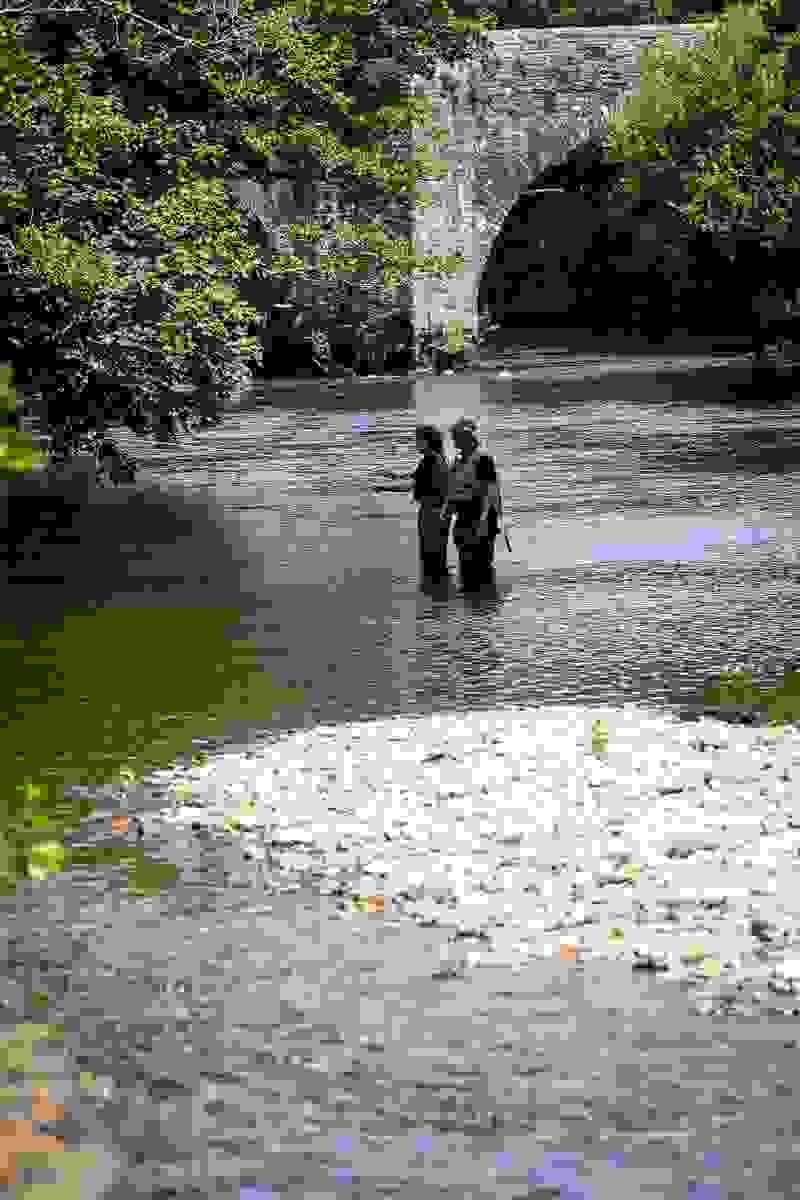
Because of the Dart’s character—often steep-banked, tree-lined, and powerful in higher water—good preparation makes a major difference. You may require thigh or chest waders in high water, while short boots can be adequate (and more comfortable) during mid-summer and low water. A good-sized landing net is strongly recommended for steep banks, and anglers should carry forceps for hook removal, ideally done in the water with minimal handling.
If intending to fish Totnes Weir Pool, please see the notes on its tidal nature, which can be found on the Sea Trout page.
Safety, Regulations & Catch & Release
Treat the river with respect—and in spate, with awe. Do not wade where you cannot see the bottom, especially in coloured water, and be aware that inches beyond a shallow ledge there could be fifteen feet of water. In unsettled weather, look out for rising water, increased colour and debris and retreat to a safe level—the river can rise several feet in a short time, particularly after thunderstorms on Dartmoor.
Fishing regulations are subject to change at short notice, so please ensure you have the latest information before fishing. By local by-law, all salmon caught before 16th June must be released, and the Association’s regulations also require anglers to return their first salmon after that date.
The Association and the Dart Fisheries Association have agreed with the Environment Agency to achieve a release rate of at least 90%, and anglers are strongly recommended to return all salmon with minimal stress: keep playing time short, avoid removing the fish from the water, and support it in well-oxygenated water if recovery is needed.